


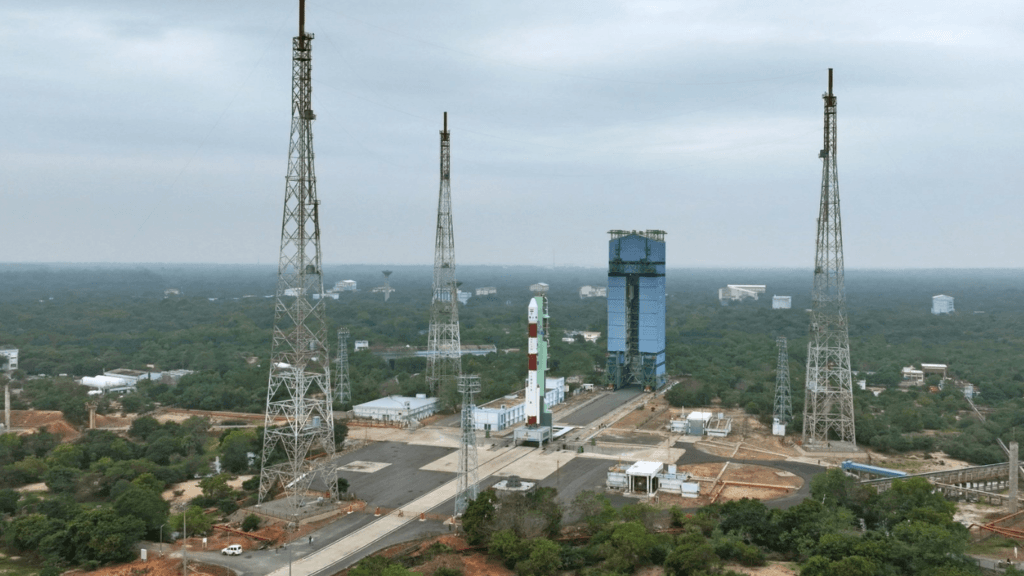
Guwahati, January 12: In a historic moment for Assam and the entire Northeast, Assam Don Bosco University (ADBU) had launch LACHIT-1, the region’s first-ever satellite, aboard ISRO’S PSLV-DL-C62 rocket on January 12 at 10:17 AM Indian Standard Time (IST), from the Satish Dhawan Space Centre, Sriharikota. The mission marks the Northeast’s formal entry into space technology. Official records confirm that no satellite from the Northeast has previously been registered, making LACHIT-1 a major milestone for the Northeast’s scientific advancement, technological self-reliance, and participation in India’s space ecosystem.
ISRO PSLV-C62 Mission Carrying LACHIT-1 Faces Technical Anomaly
The Mission has suffered anomaly during end of the PS3 stage, which result the loss of connection.
ISRO Stated, “The PSLV-C62 mission encountered an anomaly during end of the PS3 stage. A detailed analysis has been initiated.”
LACHIT-1: A Student-Led Mission with Regional Participation
The satellite has developed under Hyderabad-based Dhruva Space’s Polar Access-1 (PA-1) programme, with support from ISRO. More than 50 students and faculty members from across Assam, Meghalaya, Nagaland, Arunachal Pradesh, and Manipur worked together on the project.
ADBU began its space programme in 2022, steadily seeding into satellite engineering, mission operations, and ground-station management. The university funded the project entirely on its own set up a Mission Control Room at its Tapesia campus near Guwahati to operate the satellite after launch.
About LACHIT-1
Named after the legendary Ahom general Lachit Borphukan the satellite reflects the region’s history and identity. Built using Dhruva Space’s flight-qualified P-DoT satellite platform under the ASTRA (Accelerated Space Technology Readiness & Access) for Academia programme, LACHIT-1 will deployed using the DSOD-TU separation system.
LACHIT-1 is a store-and-forward amateur radio satellite. It can receive short messages from Earth, store them onboard, and transmit them later during subsequent orbits. This feature can be especially useful during floods, landslides, and communication blackouts, which are common in the Northeast.

Environmental Monitoring and Disaster Use
For about 12 months, the satellite will also collect atmospheric and environmental data using Internet of Things (IoT) technology, including information on air pollution, temperature, and humidity. Vice-Chancellor Fr Jose Ralely described the mission as a statement of intent from the Northeast, emphasizing its importance for disaster communication and future scientific growth.
Mission Director Prof Vikramjit Kakati, who also heads ADBD’s Research and Development Cell, said the project gives students hands on experience across the entire satellite lifecycle from design and testing to launch readiness and in orbit operations.
Global Amateur Radio Access
Once operational, licensed amateur radio operators worldwide will be able to use Lachit-1 for communication and experiments, in partnership with the National Institute of Amateur Radio. ADB and Dhruva Space will also conduct training programmes and workshops focused on disaster response communication. Dhruva Space director Avinash Maramraju said the mission proves that advanced space capability is no longer limited to a few locations, but can emerge wherever institutions are ready to build real systems.
A Milestone for the Region
With this launch, the Northeast takes its first-step into space exploration, showcasing local talent, regional collaboration, and growing scientific capability. The mission also highlights ADBUT’S, rising role in research and innovation-it holds an A grade from NAAC and is the first private university in Northeast India to receive SIRO certification from DSIR.
LACHIT-1 is not just a satellite-it is a symbol of ambition, learning, and the Northeast’s place in India’s space future.
Edited by Ankita Dev

 launch LACHIT-1, the region's first-ever satellite)