


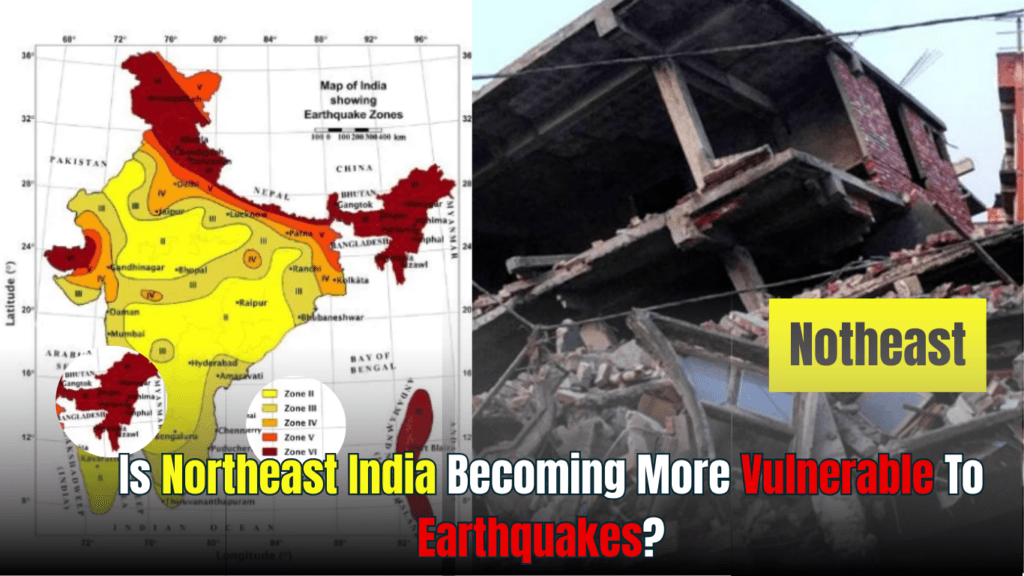
Earthquakes are not new to Northeast India. States like Assam, Meghalaya, Arunachal Pradesh, Manipur, and Mizoram lie in one of the most seismically sensitive regions of the country. Frequent tremors witnessed in recent years have once again raised an important question – is the region becoming more vulnerable to earthquakes? Leading researchers to investigate the Region’s Vulnerability to Earthquakes – Northeast India
Why Earthquakes Are Common in the Northeast?
The Northeast lies close to the boundary where the Indian tectonic plate collides with the Eurasian plate. This ongoing movement between these plates creates constant pressure beneath the earth’s surface, which is released in the form of earthquakes. Several active fault lines, including the Kopili, Brahmaputra, and Indo-Myanmar faults, pass through the region, making earthquakes inevitable.
Because of this geological setting, most of Northeast India falls within a high seismic risk zones, and therefore there is a reasonable expectation for strong earthquakes to occur over time.
What History Tells Us?
The region has experienced some of the strongest earthquakes in India’s history. The 1897 Assam earthquake and the 1950 Assam-Tibet earthquake, which caused massive destruction and loss of life. These events clearly shows that the likelihood of continued earthquakes risk is long-term.
Do Earthquakes Happen More Often Now Than Before?
Experts say that the number of earthquakes have really not gone up by a significant amount either, but improved monitoring systems now detect even small tremors. The number of people and buildings in areas that are prone to earthquakes has however increased rapidly with urban growth in the cities of Guwahati and Shillong.
How Human Activity Plays a Role in Increasing Earthquake Vulnerability?
Unplanned construction in hilly areas increases instability and raises the risk of severe damage during earthquakes.
Improperly designed buildings are more likely to collapse even during moderate seismic activity.
Deforestation increases vulnerability of natural slopes to landslides, and structural damage during an earthquake.
Older buildings not designed for seismic resistance faces greater risk of collapse and serious damage.
All these factors contribute to serious safety issues and create widespread fears, even during mild earthquakes.
As a result, even moderate earthquakes can cause serious concern.
The Way Forward
Earthquakes cannot be prevented but unplanned constructions, weak safety enforcement, deforestation, and old buildings, increases vulnerability to damage. In order to lessen the impact necessary precautions should be taken and these are –
· Retro-fitting buildings identified as vulnerable (especially schools and hospitals) can lower risk during moderate and/or strong earthquakes.
· Public education and awareness about earthquakes and help prepare communities to act immediately and safely during an earthquake emergency.
· Disaster preparedness drills and mock exercises help improve coordination, readiness, reduce panic, and minimize potential life loss.
As a result, even moderate earthquakes can cause serious concern.
Conclusion
Northeast India is not becoming more earthquake-prone, but it is becoming more vulnerable due to growing population and infrastructure. Preparedness, safe construction, and awareness will help protect people to live safely in earthquake-prone areas of Northeast India.