


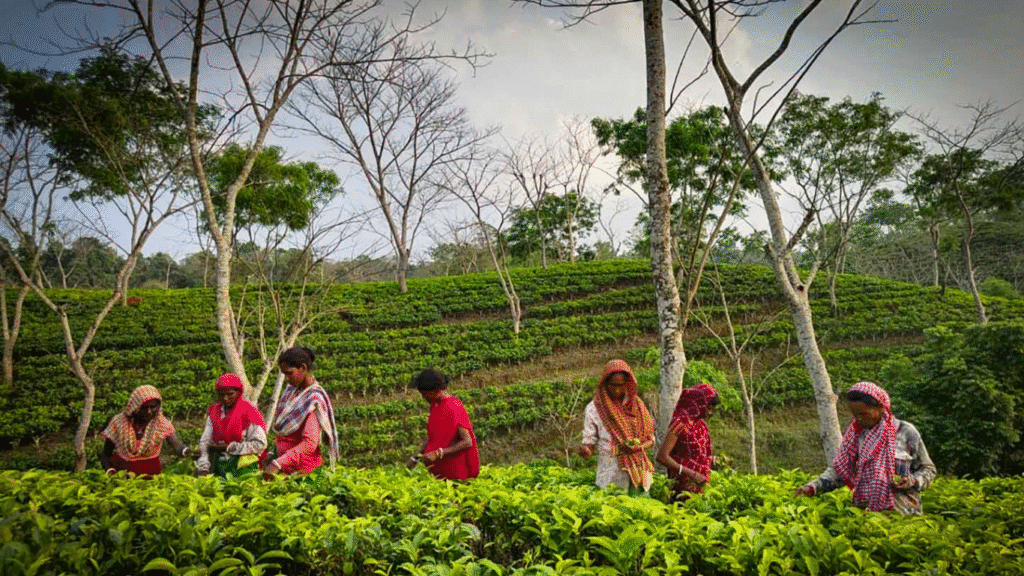
The tea industry in Assam has existed for more than 200 years, yet the workers who powered this sector lived their entire lives without any claim over the land they stayed on. Most of them brought to Assam during the British era from regions such as the Chota Nagpur Plateau and parts of eastern and central India. Deceptive recruitment and harsh working conditions defined their journey, and for generations, their homes remained tied to their employment. Losing their job meant losing their shelter — a reality unchanged for centuries.
That long wait finally began to end on November 28 during the Winter Session of the 15th Assam Legislative Assembly. The Assembly cleared the “Assam Fixation of Ceiling on Land Holding (Amendment) Bill, 2025,” a landmark step that now enables tea workers living in labour lines to receive land pattas. With this decision, thousands of families expected to gain permanent and secure housing for the first time.
The amendment removes “labour lines” from the definition of ancillary land, making it possible for the government to reclaim excess estate land and distribute it among tea garden workers — with a maximum allotment of one bigha per family.
The Bill, introduced by Minister Keshab Mahanta, triggered a powerful debate inside the Assembly. While the Opposition supported the core objective, they also proposed broadening the scope to include all tea-dwelling communities and reducing the overall land ceiling. Legislators across parties discussed worker categories, fair land distribution, and the rights of permanent as well as temporary residents.
Tensions briefly rose when AIUDF demanded that similar land rights should extend to char areas, prompting objections from the ruling benches. Chief Minister Himanta Biswa Sarma described the Bill as “a long-awaited correction of historical injustice,” announcing that a dedicated housing scheme for tea workers will introduced within two months.


“They may have lived here for five or six generations, yet they never had ownership over the land,”
— Kaushik Rai, Minister, Assam
After the Bill passed, Minister Kaushik Rai — who also oversees Food, Public Distribution & Consumer Affairs, and the Mines and Minerals Department — highlighted the long-standing struggles of tea labourers. He noted that many families had lived on tea estate land for generations without legal rights. Low wages prevented them from ever buying land, and losing their job meant being forced out of their homes. “This Bill finally changes that reality after two centuries,” he said.
Rai also mentioned various welfare initiatives already implemented for tea communities — such as Tea Garden Model Schools, reservation benefits, wage hikes, Jagannath Community Halls, and direct financial support including the Eti Koli Duti Paati scheme, which has provided ₹5,000 to more than 6.5 lakh workers. A comprehensive housing assistance programme is also in the pipeline.
Speaking about wage disparities between the Barak and Brahmaputra valleys, Rai acknowledged the current difference — ₹250 in the Brahmaputra Valley and ₹228 in the Barak Valley. He blamed the gap on previous administrations and said the present government has already increased wages by ₹115 in three phases across both regions. Efforts are underway to equalise the rates and push wages beyond ₹250.
The passage of the Bill is being celebrated as one of the most significant policy moves for Assam’s tea labour community in recent history. Many believe it brings long-denied dignity and security to the people who helped build Assam’s tea economy. As the Bill sailed through the Assembly with a clear majority, tea garden communities welcomed the news with emotional celebrations, including traditional Jhumur performances — marking a moment of deep pride and long-awaited justice.